
Last updated date: March 24, 2026 | 8:39 pm
Table of Contents
Managing taxes for small business owners in the Philippines can be stressful, especially
during tax season. However, with the right tax tips, you can legally reduce taxes, maximize
deductions, and stay organized, not just during the April 15 deadline but all year round.
Understanding which taxes apply to your business, tracking deductible expenses, and staying
up to date on regulatory changes are key to uncovering opportunities to save. Proper tax
planning also supports better cash flow, so your business runs smoothly.
Furthermore, the Ease of Paying Taxes (EOPT) Act allows business owners to enjoy lower fees,
simplified requirements, and a hassle-free tax filing process.
Below, we highlight easy-to-follow tax strategies that any small business owner can apply to
feel more confident and less stressed every time tax season comes up.
TL;DR: Key Takeaways
Essential Tips for a Stress-Free Tax Season
What are stress-free tax tips for small businesses?
Navigating tax season can be challenging, even for seasoned business owners. While the
annual income tax return (ITR) deadline typically falls on April 15, the secret to a
stress-free experience is consistent, year-round proactive tax preparation.
Here are 6 practical tips to help you manage tax compliance stress-free every tax season and
the rest of the year.
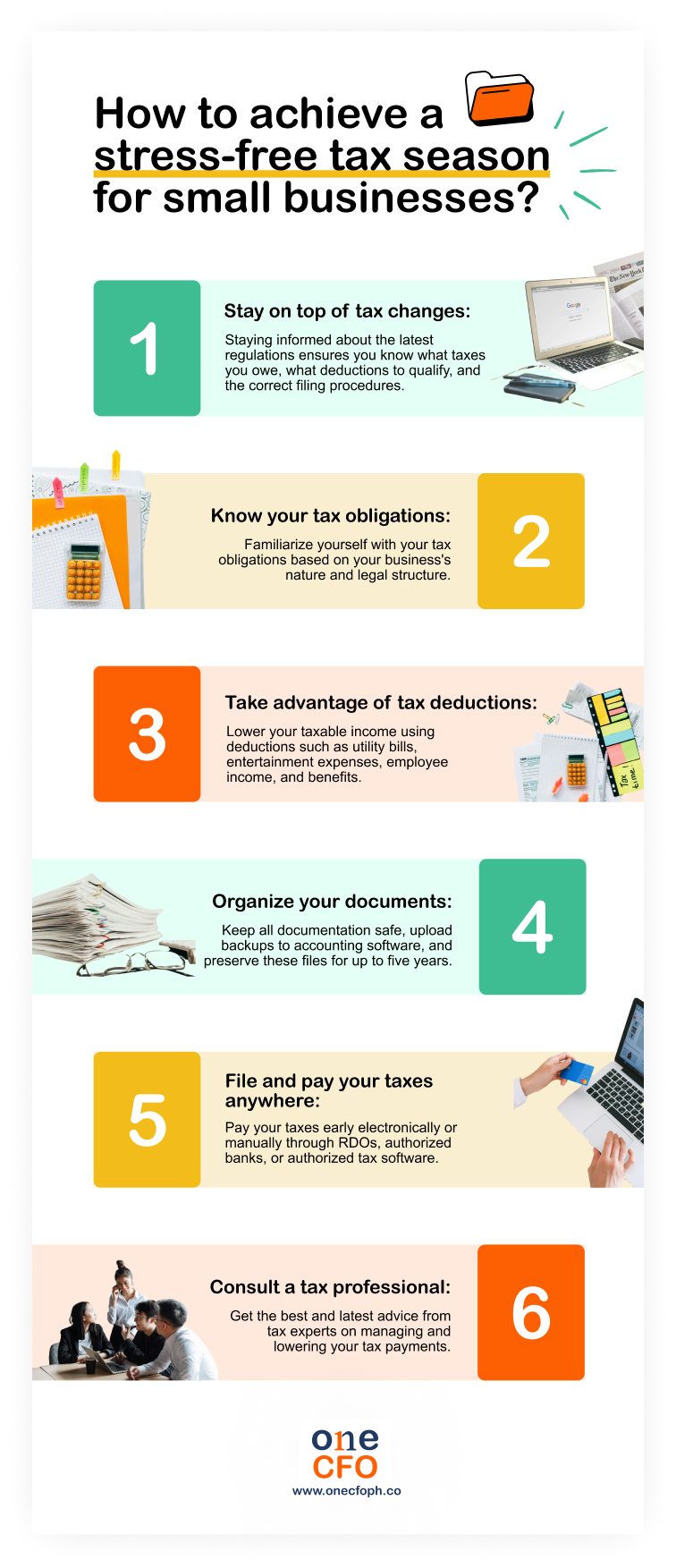
Tip #1: How do you stay updated on changing tax laws in the Philippines?
Staying up to date on tax law changes in the Philippines requires proactively monitoring
official BIR circulars and updates from the Department of Finance (DOF).
Running a business is no small feat; keeping up with the ever-changing tax regulations can
feel like another hurdle. However, staying informed is the most effective way to know if
there are BIR tax laws that affect your compliance.
Knowing the latest rules allows you to accurately calculate how much tax you owe, identify
which deductions you can claim, and follow the correct filing procedures. Furthermore,
understanding the specific tax regulations that apply to your business, such as the Ease of
Paying Taxes (EOPT) Act, ensures you stay compliant and avoid costly penalties.
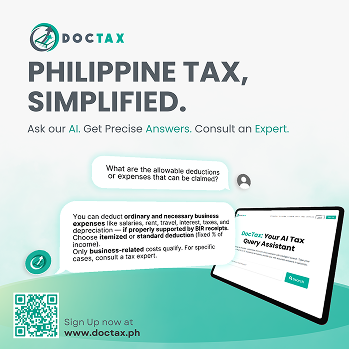
When the government tax resources feel overwhelming, AI-powered tools like DocTax
are
specifically designed to simplify the process.
DocTax provides instant, reliable answers to the Philippines tax questions, making it a
practical partner for SMEs. Furthermore, if your situation requires deeper insights and
expertise, Doctax also facilitates consultation with verified tax professionals to handle
your specific compliance issue.
What is the EOPT Act?
The Ease of Paying Taxes (EOPT) Act, signed into law on January 5, 2024, remains the latest
major reform of the Philippine tax system aimed at making it more taxpayer-friendly and
efficient.
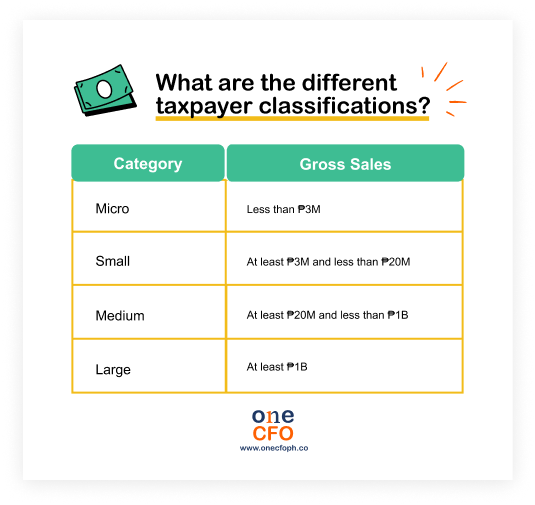
A critical aspect of the EOPT Act is that taxpayers are now
classified into new categories
based on their annual gross sales, making tax administration more responsive and tailored to
each taxpayer’s needs.
Important EOPT information taxpayers should be aware of:
How does the EOPT Act benefit micro and small taxpayers?
How does VAT work in the Philippines for small businesses?
Value-Added Tax (VAT) in the Philippines works by adding a 12% tax to the sale of goods and
services. VAT-registered small businesses collect this tax from customers and remit it to
the BIR.
Small businesses with gross sales or receipts below the VAT threshold are exempt from
registration and from paying VAT. The current threshold is Php 3 million, but under the EOPT
Act, adjustments will be made every 3 years based on the Consumer Price Index (CPI)
published by the Philippine Statistics Authority.
For business owners who need to pay value-added tax (VAT), familiarizing yourself with the
new VAT rules will inform you of your requirements for VAT and income tax filing.
VAT-registered businesses should now use gross sales as the basis for VAT on both goods and
services. Previously, taxpayers had to use different documents as their VAT basis: gross
sales for goods and gross receipts for services.
By making the basis uniform across all sales transactions, businesses will find it easier to
track documentation, since they will only need to refer to their invoices going forward.
Do digital service providers have to charge VAT?
Yes, digital service providers (DSPs) in the Philippines are required to charge 12% VAT based on the sale or exchange of digital services consumed in the country.
Tip#2: Why is it important to know your tax obligations
Knowing your tax obligations is the best way to protect your business from surcharges and
penalties that come with non-compliance.
Aside from familiarizing yourself with tax regulations, you should also know the taxes that
apply to your business, which generally depend on your business's legal structure.
Understanding business-specific tax obligations is key to a smooth and stress-free tax
season.
Here’s why being informed is a strategic approach for every small
business owner:
What are the applicable tax rates for SMEs?
For sole proprietorships and partnerships, business owners must pay personal income tax
quarterly at a graduated rate of up to 35% or a fixed rate of 8%.
However, note that the 8% rate is only available to businesses whose sales don't exceed the
current VAT threshold of ₱3M.
If you opt for the graduated tax rates, your business will also be subject to a 12% VAT or
monthly percentage tax, also called sales tax or business tax, equal to 3% of your gross
sales, as applicable.
Corporations, on the other hand, are subject to corporate income tax of up to 25%.
Like the
other legal structures, corporations also have a VAT threshold of ₱3M, and exceeding this
would result in an additional 12% tax.
Businesses with salaried employees must also remit taxes they withheld from their employees' income to the BIR.
Tip #3: How can small businesses legally reduce taxes in the Philippines?
While all businesses have a responsibility to pay taxes, there are smart strategies to
minimize your tax burden legally. This is where tax deductions come in: they allow
you to
subtract specific expenses from your taxable income, ultimately reducing the taxes your
business owes.
Furthermore, the recent changes to tax regulations have simplified the process of claiming
allowable deductions.
The EOPT Act has removed the requirement to pay withholding tax before claiming a tax
deduction on certain payments and expenses. Previously, businesses must prove that they paid
withholding taxes to the BIR before claiming deductions.
With the tax rules being eased, claiming allowable tax deductions is easier. This translates
to a reduced tax burden and increased cash flow for reinvestment in operations, growth
initiatives, or other strategic priorities.
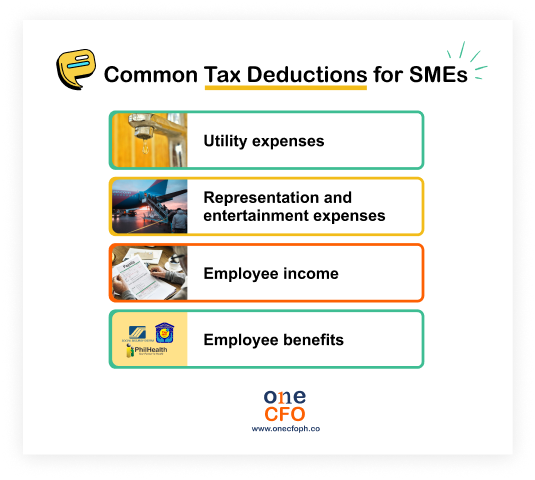
Some of the most common tax deductions are:
Watch this video to learn the secrets to maximizing tax deductions:
Tip#4: How should small businesses organize their tax documents?
Small businesses can organize tax documents by keeping invoices, receipts, and other
financial records properly labeled and dated in one place. Storing copies digitally and
keeping backups also helps ensure everything is ready for tax filing or audits.
Meticulous record-keeping might seem like a chore, but it's one of the secret weapons to a
stress-free tax season.
Proper bookkeeping involves
organizing financial documents during tax season and at all
times. These documents may include sales invoices, official receipts, checks, utility bills,
etc.
Your financial documents will serve as your reference when calculating how much taxes to
pay. At the same time, BIR may request a copy of these documents, especially if the business
is audited or when declaring tax deductions.
Moreover, the EOPT Act requires taxpayers to preserve their books of accounts and accounting
records for ten years after the date or
deadline for filing the returns.
To better safeguard your documents, it’s also best to upload backups of your files to
accounting software.
Avoid costly mistakes and ensure your data are accurate with these proven bookkeeping tips:
Tip #5: Can you file and pay your taxes anywhere in the Philippines?
The EOPT Act includes the ‘File and pay anywhere’ process, providing more convenience to
taxpayers in settling their tax payments.
Previously, taxpayers could only file and pay their taxes within the jurisdiction of where
their business was registered. If they filed in the wrong venue, the business had to pay the
25% surcharge on the tax due.
But with ‘File and pay anywhere,’ taxpayers like SME owners can now file anywhere without
any surcharge. This option gives taxpayers more flexibility in filing their tax returns.
In addition, payments are allowed electronically or manually through payment channels such
as authorized agent banks, RDOs, and authorized tax software.
How can you avoid missing tax deadlines?
There are many ways business owners can manage tax deadlines and avoid late filing of
taxes.
One is setting up calendar reminders, whether on your phone or digital business accounts,
for easier tracking. This way, you can proactively track when your deadlines will be and
ensure you’re prepared.
You can also set these tax reminders on your accounting software like Xero. Using accounting
software gives entrepreneurs more flexibility in handling finances, and they can even set up
other automated reminders for payroll, invoice payments, and such.
Tip #6: Should small businesses consult a tax professional?
Business owners should engage the help of a tax professional to ensure a stress-free tax
season.
Consulting a tax professional is beneficial to SMEs for the following reasons:
Enlisting the expertise of tax professionals offers businesses, regardless of size and stage, comprehensive support they could use to make tax season less complex and stressful.
Do small businesses need to register with the BIR?
The short answer is yes if you’re still unregistered and wondering if you should register
your business with the BIR. Registering with the BIR ensures your business complies with the
government.
Running a business is already challenging enough without the looming possibility of
penalties and fines if you’re found unregistered.
Under RMC No. 055-2025, failure to register your business
can result in a fine of ₱5,000 to
₱20,000 and a term of imprisonment of six months to two years.
Moreover, being a registered business gives you access to more financial services. Opening a
business bank account or acquiring loans may require a tax identification number (TIN),
which you can only obtain from the BIR.
SMEs in the Philippines are also most likely to deal with suppliers registered with the BIR
and able to issue sales invoices. Sales invoices are important for documenting transactions,
tracking business expenses, and supporting tax deductions.
Do small businesses still need to pay a BIR registration fee?
Small businesses no longer need to pay the annual BIR registration fee. Under the EOPT Act,
the BIR has ceased collecting the ₱500 annual registration fee (ARF).
While the BIR has stopped collecting the Annual Registration Fee (ARF), businesses should
already have updated or replaced their old Certificate of Registration (COR) that still
reflects the ARF. The BIR allowed updates until December 31, 2024, so companies should now
be using an updated COR without the ARF to ensure full compliance.
Make tax season less stressful for your small business
By staying informed about tax regulations and obligations, keeping meticulous records, and
taking advantage of the EOPT Act’s simplified processes, you can transform tax season from a
stressful ordeal into a manageable task.
For even greater peace of mind, consider working with OneCFO, a strategic finance partner
for growing businesses across Southeast Asia. With their fractional CFO expertise, they help
SMEs and startups avoid costly tax errors, meet compliance deadlines, and maximize available
tax deductions.
Watch this video to see how OneCFO supports businesses in navigating tax compliance
challenges with expert financial guidance.
As businesses grow, financial decisions become more complex. Access to experienced financial
leadership helps companies stay compliant while building stronger financial foundations for
the future. OneCFO provides CFO-level guidance that supports better oversight, clearer
financial insight, and more confident decision-making.
If you’d like to learn more, visit onecfoph.co or contact us at [email protected] to
see how
we can support your business through tax season and beyond.
Read our disclaimer here.
About OneCFO
Based in the Philippines, OneCFO provides tech-enabled fractional CFO, bookkeeping, tax management, and payroll
support to startups, scaleups, and small- to mid-sized businesses across Southeast Asia.
We help companies manage cash flow, fundraising, and financial strategy. With our fractional CFO expertise,
business owners and finance teams gain clarity in finance and the confidence to grow.