
Last updated date: February 9, 2026 | 11:19 pm
Table of Contents
 Editor's Note: This
article reflects current invoicing rules and compliance guidance as
of 2026.
Editor's Note: This
article reflects current invoicing rules and compliance guidance as
of 2026.
Many business owners in the Philippines are still confused about whether to issue a Sales Invoice or an Official Receipt, especially after the changes introduced under the Ease of Paying Taxes (EOPT) Act. This confusion is common among service providers, small businesses, and growing companies trying to stay compliant with BIR requirements.
Since the EOPT regulations were released in April 2024, the focus has shifted from
understanding the change to proper implementation and compliance.
This guide explains the difference between a Sales Invoice and an Official Receipt, when to
issue each, and what businesses need to do today to stay compliant.
What is the EOPT Act?
The Ease of Paying Taxes (EOPT) Act,
signed on January 5, 2024, modernizes and simplifies
tax administration in the Philippines, making it more taxpayer-friendly.
This regulation outlines amendments to our tax system,
including the reclassification of
businesses, easier tax return filing, and simplified value-added tax (VAT) rulings.
Watch this to learn more about the EOPT Law and other recent tax changes in the country:
In addition, the EOPT Act involves significant changes to the invoicing requirements,
pushing businesses to now use invoices instead of official receipts (ORs).
The Bureau of Internal Revenue (BIR) also released the following memoranda—RR 7-2024 and
RR 11-2024—to provide more
clarification on this transition.
What are the differences between an official receipt and an invoice?
Before the EOPT Act took effect on April 27, 2024, companies could use official receipts or
invoices depending on the nature of their business.
Businesses selling goods and properties use invoices as their primary documents, while those
selling services or leasing properties use official receipts.
However, the EOPT Act has amended the use of these documents.
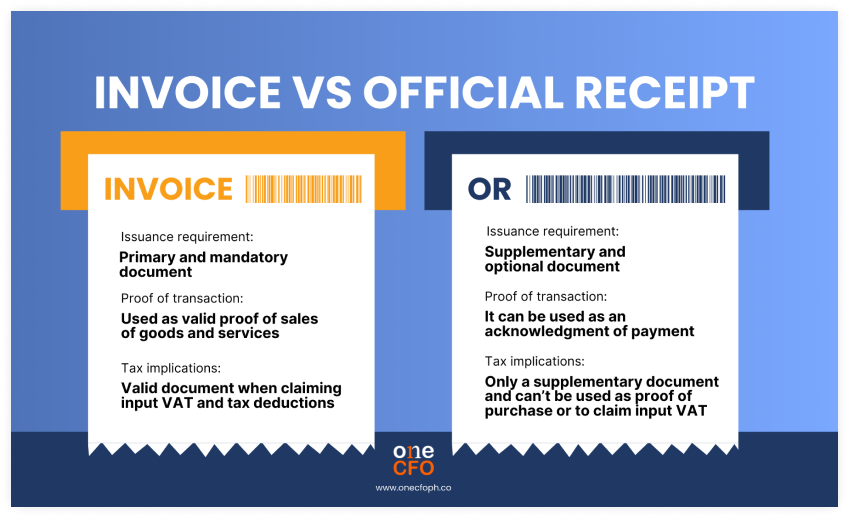
Here are the key differences between official receipts and invoices:
Issuance requirement
According to the EOPT Act, businesses should now issue invoices as the primary document for
selling goods and services.
Also, it’s worth noting that an invoice doesn’t just refer to a sales invoice. Businesses
can add any descriptive name to label their invoices, such as “Cash Invoice,” “Credit
Invoice,” “Service Invoice,” “Billing Invoice,” and more.
On the other hand, official receipts are only secondary and optional. If your business still
decides to use ORs, you must register them to the BIR as a supplementary document to get a
new Authority to Print (ATP).
Proof of transaction
Under the EOPT Act, businesses must use invoices as proof of their sales, regardless of
whether customers pay in cash or on credit. If the customer pays in credit, meaning the
business collects the payment later, business owners should not issue a second invoice upon
collection.
Instead, businesses can issue an official receipt as proof or acknowledgment of payment once
the customer settles their outstanding balance.
Tax implications
If you want to take advantage of tax-deductible expenses, remember
that invoices are
considered valid documents for tax deductions.
Moreover, VAT-registered businesses can now use the invoices they receive as input VAT when
buying from other VAT-registered companies.
Meanwhile, official receipts are no longer valid when claiming a tax-deductible expense or
input VAT.
Frequently Asked Questions About EOPT Invoicing Changes
Since the release of the EOPT Act, many businesses are still adjusting to the new invoicing rules. To help clarify what applies today, this section addresses the most common questions about Sales Invoices, Official Receipts, and proper invoicing compliance.
What are the two categories of invoices?
Invoices are categorized based on VAT status: VAT invoices for taxable sales and Non-VAT
invoices for exempt or non-VAT transactions. Each must show the correct breakdown of
VATable, zero-rated, and exempt sales.
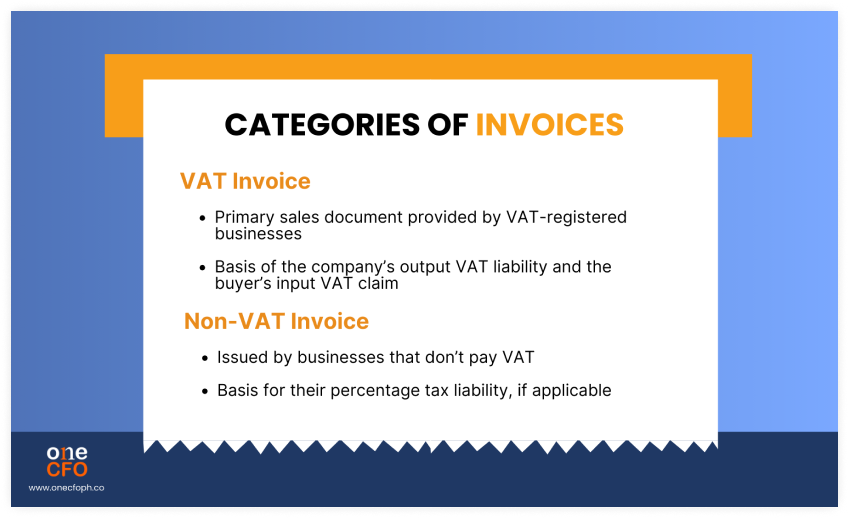
The BIR defines an invoice as a written account
evidencing the sales of goods and services
issued to customers. There are also two categories of invoices as follows:
If you’re a VAT-registered business selling zero-rated or VAT-exempt products, note that you
can use a single invoice for mixed transactions, including goods/services subject to VAT,
Zero-rate, and VAT-exempt sales.
When doing so, it’s essential to show a breakdown of the amounts for each type of sale:
VATable sales, VAT amount, VAT-exempt sales, and zero-rated sales.
When should you issue an invoice?
VAT-registered businesses must issue an invoice for every sale, regardless of amount.
Non-VAT businesses must issue an invoice when the sale exceeds ₱500, the buyer requests it,
or total daily sales under ₱500 exceed ₱500.
The timing of when to issue an invoice depends on whether you’re VAT-registered and the
amount involved in the transaction.
VAT-registered sellers should always invoice all sales transactions, regardless of the
amount.
Meanwhile, non-VAT-registered businesses must issue an invoice when they meet at least one
of these three conditions:
Also, note that the BIR will adjust the ₱500 threshold every three years based on the Consumer Price Index.
What happens to your existing official receipts?
Unused Official Receipts can still be used as supplementary proof of payment, or they can be
converted into invoices by striking out “Official Receipt” and stamping “Invoice.”
If you still have unused booklets of official receipts in your hand, don’t throw them away!
Even though invoices are now the primary document, you still have two options for utilizing
your unused receipts until they’re fully consumed.
The first option is to use your remaining receipts as supplementary documents for your
business. If you still issue an invoice for the same transaction, you can issue a receipt to
acknowledge your customer’s payment.
If opting for the first option, stamp the OR with the words “THIS DOCUMENT IS NOT VALID FOR
CLAIM OF INPUT TAX.” Doing so reminds buyers that they can’t use ORs to claim input tax.
The second option is to convert unused receipts into invoices, which is very beneficial for
businesses that have yet to print their invoices.
To do this, just strike out the words “Official Receipt” in your OR and stamp it with
“Invoice,” “Sales Invoice,” “Cash Invoice,” or any other variation that includes the word
“Invoice”.
Additionally, you must report the inventory of unused receipts to the BIR to be converted to
invoices.
What about businesses using cash registers or POS machines?
Businesses with CRM or POS systems can replace “Official Receipt” with “Invoice” in their
system without prior BIR approval, but must report the starting invoice serial number to the
BIR.
If your business uses cash register machines (CRM) and point-of-sale (POS) machines, you can
simply replace “Official Receipt” with “Invoice” in your systems without notifying the BIR.
However, these businesses must still submit a notice to the BIR specifying the invoice’s
starting serial number, which should follow the serial number of the last issued OR.
Are online sellers affected by the invoicing regulations?
Yes. Online sellers using e-receipting or e-invoicing software must issue invoices instead
of traditional receipts and report their starting serial number to the BIR.
Similar to the new withholding tax rule, the recent
changes in invoicing regulations are
also applicable to online sellers.
Although online sellers don’t use CRM or POS, they typically rely on e-receipting or
e-invoicing software to issue their sales documentation. Like businesses using CRM and POS,
online sellers can replace “Official Receipt” with “Invoice” in their software.
Additionally, they must report to the BIR the starting serial number of their invoice,
following the same procedure as those with CRM and POS.
What about businesses using computerized accounting or books?
Businesses using computerized accounting systems or computerized books of account must
ensure their system configuration complies with current BIR invoicing rules and that any
system changes are covered by an approved CAS or CBA application.
If your business uses a computerized accounting system (CAS) or computerized books of account (CBA),
you should reconfigure your systems and file for a new application to use CAS
or CBA.
Filing a new application involves surrendering your current Acknowledgement Certificate (AC)
or Permit to Use (PTU) and applying for a new one.
The BIR previously required affected businesses to complete CAS or CBA updates by December
31, 2024. While this transition period has passed, businesses that updated or modified their
systems must ensure their CAS or CBA is properly reconfigured and covered by an approved BIR
application.
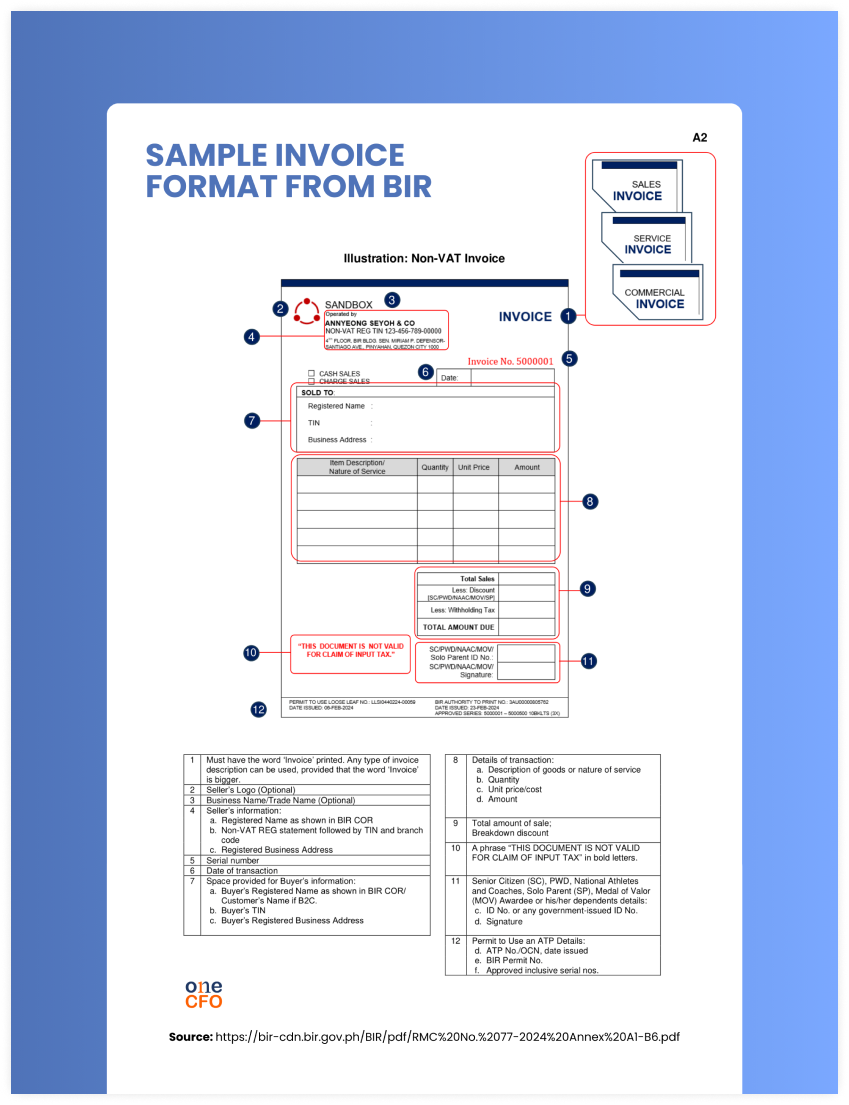
What should be the format of an invoice?
A compliant invoice must include the seller’s TIN, registered business name and address,
invoice label and serial number, buyer details, itemized goods/services, VAT breakdown (if
applicable), and total amount.
Now that invoices are the primary document for proof of sales, businesses should secure an
Authority To Print (ATP) from the BIR before going to an Accredited Printer to print their
invoices.
Here are the following information to include in your invoice format:
What are the consequences of non-compliance?
Failing to issue the proper invoices, using ORs as primary proof of sale, or incorrect
documentation can lead to fines (₱1,000–₱50,000) and even possible imprisonment under BIR
rules.
Non-compliance with the new invoicing regulations set by the EOPT Act, such as non-issuance
of invoices, failing to stamp an OR, and the like, is subject to a penalty of ₱1,000 to
₱50,000.
In addition, non-compliant business owners may be imprisoned for two to four years.
Are there any e-invoicing updates businesses should know about in 2026?
Yes. While the core invoicing rules introduced in 2024 remain in effect, the major focus in
2026 is on electronic invoicing (e-invoicing)
compliance and proper implementation.
In 2026, businesses are expected to move beyond understanding the invoicing rules and focus
on how invoices are issued, recorded, and transmitted.
Selected taxpayers, particularly e-commerce sellers, large taxpayers, and businesses using
computerized accounting systems, are required to comply with BIR e-invoicing requirements,
with deadlines extending through December 31, 2026.
At the same time, businesses must ensure that all invoices, whether electronic or manual,
contain the mandatory information and fields required by the BIR.
Using Official Receipts as primary sales documents, issuing incomplete invoices, or failing
to comply with e-invoicing requirements can still result in fines or legal penalties.
Still Have Questions About Philippine Tax or Invoicing?
Some tax and invoicing situations don’t fit neatly into FAQs. If you have specific questions
about BIR invoicing rules, e-invoicing, or other Philippine tax matters, you can ask
directly through DocTax or connect with a licensed tax professional.
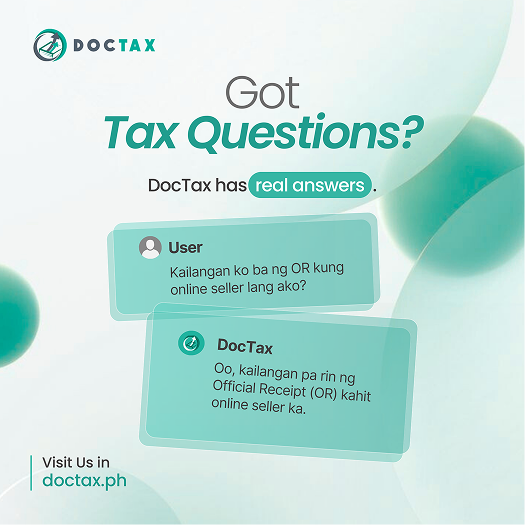
DocTax lets business owners get reliable, Philippines-specific tax answers without guesswork
— helping you make informed decisions and stay compliant.
👉 Ask a
Philippine tax question through DocTax.
Stay compliant with the new invoicing regulations
Staying compliant with BIR invoicing requirements remains essential for businesses in the
Philippines.
While the core rules under the EOPT Act remain in effect, the focus today is on proper
implementation, accurate documentation, and readiness for electronic invoicing to avoid
penalties and compliance issues.
After understanding the differences between Sales Invoices and Official Receipts, the next
step is to ensure that your invoicing process, systems, and records align with current BIR
requirements.
Sales Invoice vs Official Receipt
Key Takeaways
If you need support navigating invoicing compliance, electronic invoicing readiness, or
broader tax requirements, OneCFO is
here to help. Our team of finance and accounting
professionals provides practical guidance to help businesses stay compliant while
supporting sustainable growth.
Visit us at onecfoph.co or email us at [email protected] to
learn how OneCFO can support your business through ongoing regulatory and tax compliance
changes.
Read our disclaimer here.
About OneCFO
Based in the Philippines, OneCFO provides tech-enabled fractional CFO, bookkeeping, tax management, and payroll
support to startups, scaleups, and small- to mid-sized businesses across Southeast Asia.
We help companies manage cash flow, fundraising, and financial strategy. With our fractional CFO expertise,
business owners and finance teams gain clarity in finance and the confidence to grow.