
April 29, 2026 | 8:10 pm
Table of Contents
Raising capital is one of the most defining challenges every startup founder faces. Whether
you’re building a fintech solution, logistics platform, or SaaS product, understanding the
types of startup funding available to you and knowing when to use each can mean the
difference between scaling and stalling.
Funding for your startup can come from investors like angel investors and venture
capitalists. Other options include joining accelerator and incubator programs or obtaining
grants to fund your startup. You may even opt for self-funding through bootstrapping.
This guide breaks down the 7 main types of startup funding, explains the key funding stages,
and helps you figure out which funding path fits your startup right now. And if you're
unsure which option fits your stage, we'll also cover how founders get expert financial
guidance, without the cost of a full-time CFO.
TL;DR: Key Takeaways on Startup Funding
What are the different types of startup funding
There is no one-size-fits-all solution to fundraising. When determining the best fundraising
method, the business has to assess its funding needs, current stage, and, sometimes, even
its industry.
Here are the common types of startup funding:
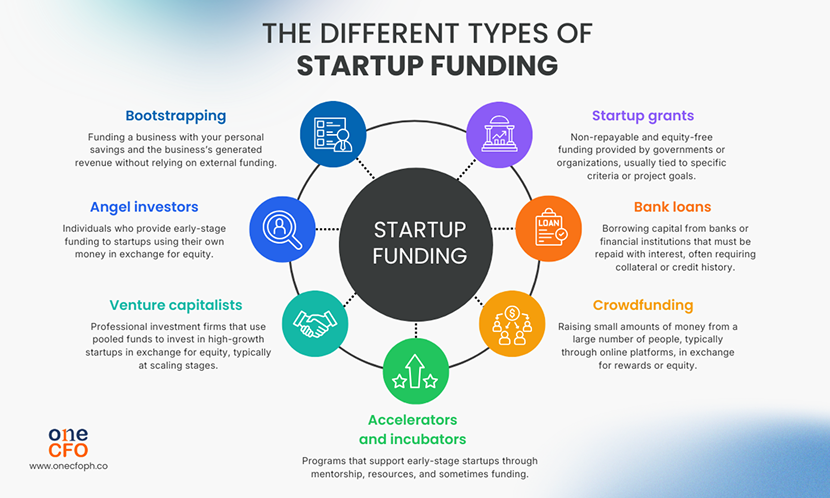
Bootstrapping
Funding your startup entirely from your own savings, personal income, or early revenue,
without taking outside capital, means you are bootstrapping.
Bootstrapped startups rely on frugal spending and proper cash flow management to optimize
the limited funds. They also prioritize customer relationships to drive growth and find
their product-market fit quickly.
Bootstrapping works best for service-based businesses, high-margin digital agencies, SaaS
products with strong early revenue, or founders who want to reach profitability before
raising. It lets you keep 100% control and ownership and proves your ideas work before you
ever ask investors for funding.
However, bootstrapping entails greater personal risk and typically results in slower growth.
If these limitations hinder your business goals, it's time to consider seeking external
funding.
Angel investors
Angel investors are individuals who invest their
personal funds in early-stage startups in
exchange for an ownership stake in the company.
Their investments typically range from tens of thousands to several million pesos, and may
come through two structures:
Unlike venture capital firms and banks, angels offer more flexible investment terms and
faster decision-making because they don’t go through corporate hierarchies. They invest
based on their own judgment and often back founders at the idea or prototype stage.
Angels typically invest in their areas of expertise. Beyond money, angel investors often
bring mentorship, industry connections, and credibility that can be just as valuable as the
capital itself.
Apart from approaching angels individually, startups can pitch to angel investment networks
such as the Manila Angel
Investors Network Inc. (MAIN) to reach a wider audience and benefit
from a more formalized process.
Venture capital
Like angel investors, venture capital firms (VCs) invest
in startups in exchange for equity
but on a much larger scale. They invest in startups that have shown early traction and are
ready to grow, funding that acceleration through successive rounds.
Due to the high-risk nature of their investments, VCs target startups with unique,
competitive products and the potential for rapid growth or market dominance. Their strategy
involves backing high-risk, high-reward companies, aiming to cover any losses with
substantial returns from their successful investments.
Startups use VC funding to rapidly scale operations, expand their team, and bring products
to market faster than they could on their own.
In return for providing capital, VCs take an equity stake and typically negotiate a board
seat or observer rights, allowing them to
provide strategic guidance and stay closely
involved in major business decisions.
Accelerators vs. incubators
If you’re building a startup, accelerators and incubators can help, but they serve different purposes. Accelerators are designed to fast-track the growth of startups with early traction and a readiness to scale. Incubators, on the other hand, focus on early-stage ideas, helping founders build and validate their idea from the ground up.
Accelerators are short-term,
intensive programs designed for startups that already have a
product or initial traction. They provide mentorship, resources, networking opportunities,
and funding in exchange for equity. These programs follow a structured cohort-based
approach, with startups completing milestones to improve their scalability.
Meanwhile, incubators cater to pre-launch and early-stage startups. They focus on refining
business ideas, validating the market, and building a solid foundation.
Aside from mentorship, incubators may offer office space, advisory support, and access to
networks, usually with more flexible timelines and often without taking equity upfront.
In the Philippines, various organizations such as AHG Lab, Founders Launchpad, and
IdeaSpace
support startups at different stages of development.
Government-led accelerators are also
available, providing startups with more options for
growth. Examples of these programs are:
Crowdfunding
Crowdfunding offers startups an easy
way to access funding by raising small amounts of
capital from a large group of people, including friends, family, potential customers, and
interested individuals.
Entrepreneurs may use social media when crowdfunding, but specialized crowdfunding platforms
offer a more organized way to showcase their business ideas.
Like traditional investors, crowdfunding supporters may seek equity or early access to
products in exchange for funding.
In the Philippines, platforms like Round One enable startups and SMEs to raise funds
through
equity crowdfunding, giving investors the opportunity to own shares in growing businesses.
Bank loans
Another way to raise capital is to borrow cash through bank loans. This method is for
startups and SMEs who want to get started or improve their business without involving
investors.
Good credit is crucial for entrepreneurs to access business bank loans with lower interest
rates and longer repayment terms. Short-term loans are also available for quick cash access
during cash flow
challenges and emergencies or to seize business opportunities.
However, taking out bank loans carries risks, so carefully assess your ability to repay the
loan to avoid worsening your financial situation.
Government grants and programs
Startups can explore grants, which are non-repayable, equity-free funds awarded to
businesses.
Grants are appealing because startups can access capital without incurring debt or
sacrificing ownership. Successfully obtaining a grant boosts a startup’s credibility through
the competitive application process and the backing of the funding organization, often a
government agency.
An example of a grant is the DICT Startup Grant Fund, which
provides businesses with up to
₱5M in capital. Similarly, the Department of Science and Technology (DOST) pioneered the
Startup Research Grant Program,
offering up to ₱3M to early-stage health startups.
What are the different startup funding stages?
Often, startups raise funds in a series of rounds, each representing a stage and milestone in a startup’s journey. In every round, the startup secures capital to continue growth, increase its value, and move to the next stage.
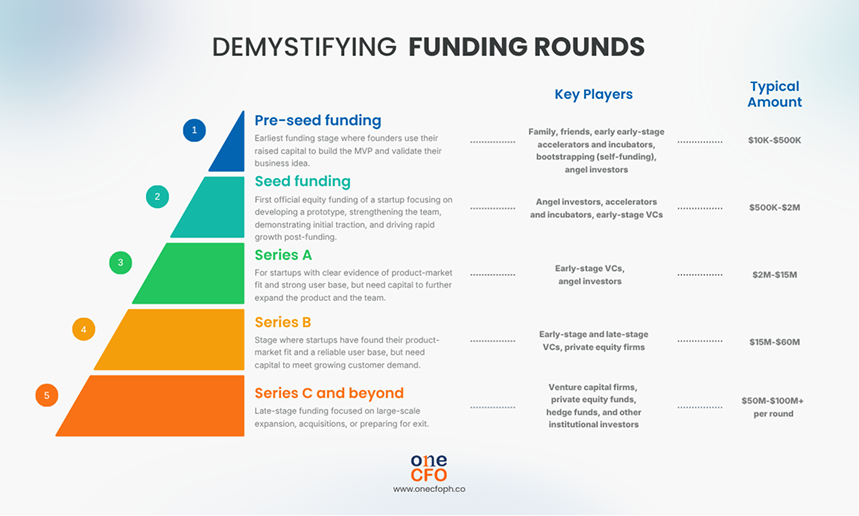
Pre-seed funding
Pre-seed funding is the earliest stage of funding for
startups, supporting founders in
launching and validating their business ideas.
Startups mainly secure pre-seed funding from family, friends, early-stage accelerators, and
angel investors, with some opting to bootstrap.
Founders use the funding to cover initial expenses for building the MVP, hiring team
members, conducting market validation, and preparing for the seed stage or product launch.
Seed funding
Seed funding marks the first official equity funding
stage for startups, where they need a
working product, proof of product-market fit, demonstrate initial traction, and strategies
to drive rapid growth post-funding.
Seed investors typically include angel investors, accelerators, incubators, and VCs.
The goals of seed funding are to expand the product capabilities, strengthen the team, and
lay the groundwork for future stages. Some companies may remain in the seed stage if they’re
already profitable.
Series A funding
A startup’s first major institutional round is called Series A. After surviving the seed
stage and demonstrating traction with KPIs like revenue or users, you’re
poised for this
kind of funding.
Series A funding is
for startups that have consistent revenue or strong user growth, a
proven business model, and a scalable product.
Investors in Series A rounds are typically VC firms and a few angels. Due diligence at this
stage is more thorough as investors seek significant investment returns.
Series B funding and beyond
Series B is all about scale. Startups raising in this
series aim to expand market share and
geographic reach, increase sales efforts, and enhance their technological infrastructure to
support accelerated growth.
Funding for this series is usually from larger VC firms, often alongside investors from
previous rounds who aim to maintain a significant stake in the company.
Series C and beyond
For Series C and beyond, the focus
shifts to large-scale expansion, acquisitions, or
preparing for an exit, whether through an IPO or an acquisition.
Startups in this stage have established strong traction and a proven business model.
Investors may include venture capital firms, private equity funds, hedge funds, and
investment banks.
How to raise capital for your startup
The fundraising process may vary slightly per stage, but mostly follows this basic format:
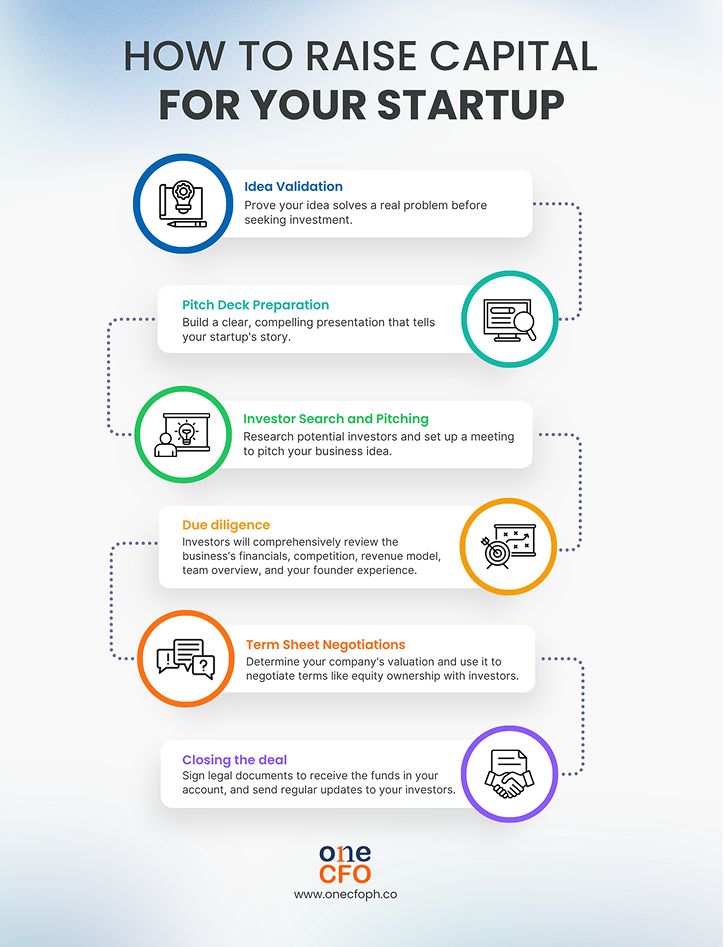
Idea Validation
Before approaching any investor, you need evidence that your idea has real-world demand.
This means talking to potential customers, testing your assumptions, and refining your
concept based on feedback.
Investors want to see that you understand your target market and that people are willing to
pay for your solution, not just that you believe in it.
A validated idea significantly increases your credibility and reduces the perceived risk for
any investor.
Pitch Deck Preparation
A pitch deck is a concise slide presentation that summarizes your business for potential
investors.
It should cover your problem, solution, target market, business model, traction, team, and
funding ask.
A strong pitch deck doesn't just present facts. It tells a story that convinces investors of
both the opportunity and your ability to execute.
Keep it clear, visually clean, and no longer than 10-15 slides.
Investor Search and Pitching
First, research potential investors aligned with your industry and company stage. Once you
have narrowed down the options, schedule an initial conversation to pitch your business
idea.
Craft a compelling pitch that covers key details, including your business overview, model,
target market, and financials.
Your goal in the pitching process is to capture investor interest, prompting further
discussions and potential capital investment.
Due diligence
Once you’ve piqued your investors’ interest, they will conduct due diligence to thoroughly
examine your company and ensure it's worth the investment.
Due diligence involves a comprehensive review of your financials, competitive landscape,
revenue model, team qualifications, and your experience as a founder to better understand
the business.
Term Sheet Negotiation
After completing due diligence and expressing interest in investing, the next step is
negotiating the terms.
Investors typically request equity in exchange for their investment, with the amount
depending on your fundraising needs and current stage.
At this point, valuation becomes central, as it determines how much of the company investors
receive in return for their capital. It serves as the basis for ensuring fair and aligned
expectations between founders and investors.
For startups that need support in understanding or validating their valuation, tools like
Isneek can help provide structured,
data-driven insights to guide more informed discussions
with investors.
Closing the deal
Once you and your investors have agreed on terms, it's time to close the deal by signing
legal documents, formalizing the transaction, and receiving the funds in your account.
You should also maintain regular communication with your investors through reports or
meetings to keep them updated on your progress.
Here’s a closer look at how startup founders need to have the right mindset, not just on
fundraising but on building their ventures.
Can startups get seed funding without an idea?
Without a validated idea, securing seed funding for startups is highly challenging. Before
investors take an interest in a business, they need to see some initial traction to
demonstrate that a product has demand and potential scalability.
Fortunately, alternative options such as grants and competitions support very early-stage
startups that have yet to develop their concepts. Aside from funding, these options offer
mentorship and exposure to help you grow and move on to the seed stage.
How to Choose the Right Type of Startup Funding
There's no universal answer, but there is a framework. Ask yourself these four questions:
1. What stage are you at?
Pre-revenue founders should focus on bootstrapping, friends and family, or grants. If you're pre-Series A with some traction, angel funding or seed VCs are the target. Revenue-generating startups have more options: RBF, growth equity, or Series A VCs.
2. How much do you need, and what will you use it for?
Be specific. Investors will ask. 'We need ₱10M to hire 3 engineers, run 6 months of paid acquisition, and reach 10,000 active users' is a real ask. 'We need funding to grow' is not.
3. How much equity are you willing to give up?
Equity is permanent. Once you've diluted it, you can't get it back. If ownership is critical to your long-term vision, explore non-dilutive options like grants or RBF first. If you need smart money and mentorship, a great angel or VC may be worth the dilution.
4. What does your business model look like?
VC funding is designed for winner-take-all, high-growth, scalable models. It's not a good fit for service businesses, lifestyle companies, or startups with modest but healthy growth. Know what kind of business you're building before deciding who to raise from.
Not sure which funding type fits your startup right now?
Most founders get stuck here, not because the options are unclear, but because the answer depends on your financials, traction, and stage. Working with a fractional CFO helps you stop guessing and start raising with a clear, investor-ready strategy.
Book a free strategy call with OneCFOFAQ: Other startup funding terms
What is bridge financing?
Between formal rounds, startups sometimes raise capital through bridge financing. This
option provides short-term capital to help startups reach the next milestone or funding
round.
The amount for bridge financing varies widely depending on the startup’s stage and needs.
What are convertible notes?
Convertible notes are a form of short-term investment that convert into equity in a future funding round rather than being repaid in cash.
What is a SAFE?
SAFE (Simple Agreement for Future Equity) is similar to a convertible note but does not accrue interest or have a maturity date.
What is ARR?
Annual Recurring Revenue (ARR) is the total predictable revenue a business expects to earn from subscriptions or recurring customers in one year.
Your funding strategy starts with financial clarity
Understanding your funding options is the first step but knowing which path fits your
business, market, and stage is where most founders get stuck.
Fundraising challenges rarely come from a lack of capital. They come from misalignment:
raising at the wrong stage, targeting the wrong investors, or entering conversations without
the financial clarity investors expect.
Without a clear funding strategy, founders spend months pitching to the wrong people,
adjusting their story mid-process, or delaying rounds until cash pressure builds.
This is where fractional CFO expertise makes the difference.
OneCFO provides
outsourced and tech-enabled CFO services for small businesses, startups, and
scaleups across the Philippines and Southeast Asia, giving founders top-notch financial
guidance without the cost of a full-time hire.
If you're ready to stop guessing and raise with a clear strategy, book a strategy call or
fill out our service inquiry form,
and our team will reach out.
Read our disclaimer here.
About OneCFO
Based in the Philippines, OneCFO provides tech-enabled fractional CFO, bookkeeping, tax management, and payroll
support to startups, scaleups, and small- to mid-sized businesses across Southeast Asia.
We help companies manage cash flow, fundraising, and financial strategy. With our fractional CFO expertise,
business owners and finance teams gain clarity in finance and the confidence to grow.